
Beautiful jewellery, real life: why 22K is not always the first choice
Your favourite jewellery should feel at home beside a laptop, under a shirt cuff and at dinner after a long working day. But when a delicate ring catches your eye, practical questions follow: Will it scratch? Could it bend? Is a higher karat worth the extra cost?
For many buyers, 22K gold feels like the natural starting point. Its high gold content and warm colour have lasting appeal. Yet the slim bands and tiny diamond settings of minimalist jewellery call for a different balance. Higher-purity gold is generally softer, so very fine 22K designs can need more care around knocks and pressure. A well-made 22K piece can still be worn regularly; the design and your routine matter.
Our starting recommendation: consider 14K for a practical balance of everyday wear and budget, or 18K if richer yellow colour and higher gold content are your priorities. Either can belong in an everyday collection when the construction suits the job.
The basics: what does karat actually mean?
Karat measures gold purity on a scale of 24. It is different from a diamond's carat, which measures weight.
- 14K gold: 14 parts gold out of 24, or approximately 58.3% pure gold. You will often see a 585 fineness mark, representing 58.5% gold.
- 18K gold: 18 parts gold out of 24, or 75% pure gold, often marked 750.
- 22K gold: approximately 91.7% pure gold.
The remaining metals form the alloy. They help shape the colour and working properties of the finished piece. The World Gold Council's guide to gold purity and colour explains these proportions.
Both 14K and 18K are real gold alloys. Neither term, by itself, means gold-plated jewellery. When shopping, check that the description specifies the gold construction and any surface plating rather than relying on colour alone.
14K gold: a practical choice for a busy jewellery wardrobe
Durability and everyday scratches
In many comparable yellow-gold designs, 14K offers a useful balance of hardness and wearability. That makes it worth considering for a band you reach for most mornings. The World Gold Council notes that harder, lower-karat alloys can suit fine designs and stone setting in its daily-wear jewellery research.
Still, scratch-resistant does not mean scratch-proof. A polished surface can develop fine marks in either karat. Alloy composition and how the metal has been worked also affect hardness; Rio Grande's guide to working with gold explains why karat is only part of the picture.
For a minimalist ring, ask about the band's width, thickness and construction. An extremely thin or hollow design deserves care even in 14K. Try imagining your usual day with it: carrying a bag, opening doors and putting on knitwear. A comfortable profile is easier to enjoy repeatedly.
Diamond prongs need good workmanship
14K is a sensible option to discuss for small diamond settings, but it cannot guarantee that a stone will never loosen. Prong thickness, setting quality and wear all matter. Well-designed 18K settings can also be secure. GIA recommends periodic checks because prongs can become damaged or loose in its guide to white jewellery metals.
If a setting catches on clothing or a stone moves, stop wearing the piece and have it inspected. When choosing a daily ring, compare how high the setting sits as carefully as you compare its karat.
Value that leaves room for personal choice
With comparable weight, design and stones, 14K will generally cost less because it contains less gold. The final price also reflects the diamonds, craftsmanship and retailer, so a fixed percentage saving would be misleading.
That lower starting cost may let you choose a better-fitting design or build a small collection gradually. Picture the piece with three outfits you already own. If it feels right with all three, that is a useful kind of value that a purity number cannot measure.
18K gold: richer colour and a considered luxury feel
Warmth you may enjoy every day
18K yellow gold typically has a fuller yellow tone than comparable 14K yellow gold. Exact shades still depend on the alloy. If warm gold is what first draws you to a piece, compare the two in daylight and against your skin before deciding.
For a small pendant, a pair of studs or a thoughtfully made band, 18K can be a lovely everyday choice. The luxury is personal: a colour you love, a pleasing finish and a piece that feels right when you put it on. Higher purity alone does not determine comfort or craftsmanship.
Sensitive skin: ask about the alloy
18K contains a smaller proportion of other metals than 14K. That can be useful when comparing particular alloys, but 18K is not automatically hypoallergenic. The identity of the metals matters, especially for earring posts and other surfaces that stay against your skin. GIA's gold engagement-ring guide highlights possible reactions to metals such as nickel and copper.
If you have a known metal sensitivity, ask for the exact alloy details, including the posts and backs. A higher karat stamp is not a substitute for that information.
Choosing 18K with confidence
Choose 18K because its colour and gold content are meaningful to you, with enough room in your budget for the design you actually want. Compare like-for-like pieces and ask about future maintenance. You do not need to dismiss 18K as too delicate for every day; you do need to match the piece to your habits.
The white gold factor: 14K, 18K and rhodium plating
White gold gets its colour from alloying gold with other metals. Many pieces also receive a thin rhodium coating for a bright white finish. Freshly plated 14K and 18K white gold can look very similar.
Rhodium gradually wears, revealing the underlying alloy, which may look warmer. That colour change does not mean the jewellery has stopped being real gold. Replating may restore the original surface appearance. GIA discusses this maintenance in its guide to white, yellow and rose gold.
Do not assume 18K automatically keeps its rhodium finish longer. Wear depends on the coating, friction and use, so there is no reliable replating timetable based on karat alone. Ask the jeweller about the finish, replating options and cost before you buy. For sensitive skin, also check the base alloy; a plated surface does not establish that the piece is nickel-free.
14K vs 18K gold: a quick comparison
| Feature | 14K gold | 18K gold |
|---|---|---|
| Purity | About 58.3% gold; commonly marked 585 | 75% gold; commonly marked 750 |
| Scratch resistance | Often the more practical choice in comparable yellow-gold designs; still scratches | Can show wear more readily in comparable designs; alloy and finish matter |
| Daily wear rating | Strong all-round choice with appropriate construction | Good choice with appropriate construction and care |
| Ideal pieces | Everyday bands, studs and small pendants | Rich yellow-gold bands, studs and pendants |
| Price | Generally lower for comparable weight, design and stones | Generally higher because of greater gold content |
These are shopping guidelines, not laboratory ratings. Neither karat makes an ultra-thin piece immune to bending, and white-gold alloys can behave differently from yellow-gold alloys.
Which should you buy?
Consider 14K if:
- You want your first everyday fine-jewellery piece at a more accessible price.
- You prefer a softer yellow tone or the appearance of plated white gold.
- You are choosing a frequently worn ring and want to discuss a practical alloy with your jeweller.
- You would rather put more of your budget towards the design, fit or diamond.
Consider 18K if:
- You love a richer yellow-gold colour and have compared it in person.
- Higher gold content is part of what makes the piece special to you.
- You are comfortable with the price and expected maintenance of the specific design.
- You have checked the alloy against any known sensitivities instead of assuming higher purity guarantees suitability.
For either choice, ask for the finished weight, dimensions, construction and care instructions. If a diamond is described as certified, ask which laboratory issued its grading report and what that report covers. The gold karat and diamond documentation describe different things.
Find your everyday piece
Start with the silhouette you can imagine wearing on an ordinary Tuesday. Explore K Gold's rings and ask our team about a dainty band, or browse our stud earrings for a simple solitaire look. Check each product's listed metal, purity and dimensions; available options vary by design.
For a personal comparison, contact the K Gold team with your preferred piece, budget and daily routine. We can help you narrow down what to ask and which available options to compare.
Frequently asked questions
Can I wear 14K gold in the shower?
An occasional splash is different from making showering part of its daily routine. We recommend removing fine jewellery before showering to limit soap residue and exposure to products. Remove it before swimming or using household cleaners: chlorine can damage gold alloys. Follow the care instructions for any stones or treatments in the piece. See GIA's jewellery care advice.
Does 18K gold tarnish or lose its colour?
Pure gold resists tarnish, but the other metals in a gold alloy can react. Surface residue and wear can also change how a piece looks. Unplated 18K yellow gold has colour throughout its alloy; it does not rely on a thin yellow coating. White gold may look warmer as rhodium wears. GIA explains the distinction between gold and its alloying metals in its yellow-gold and rose-gold guide.
Will a thin 14K ring bend or a diamond come loose?
It can happen. Karat alone cannot protect a very fine band from force or keep a damaged prong secure. Choose suitable dimensions, remove rings for heavy lifting or workouts, and have worn settings checked. If a stone feels loose, leave the ring off until a jeweller has inspected it.
Is 18K worth the extra money for daily wear?
It can be, if you value its higher gold content and the richer colour of 18K yellow gold. If your priority is an accessible, versatile everyday piece, 14K may be the better fit. Compare the actual jewellery, including its weight, construction, stones and maintenance, rather than treating the higher number as an automatic upgrade.
The right piece should make getting dressed feel a little more personal. Choose the gold you enjoy looking at, the construction your routine needs and a price you feel comfortable with.
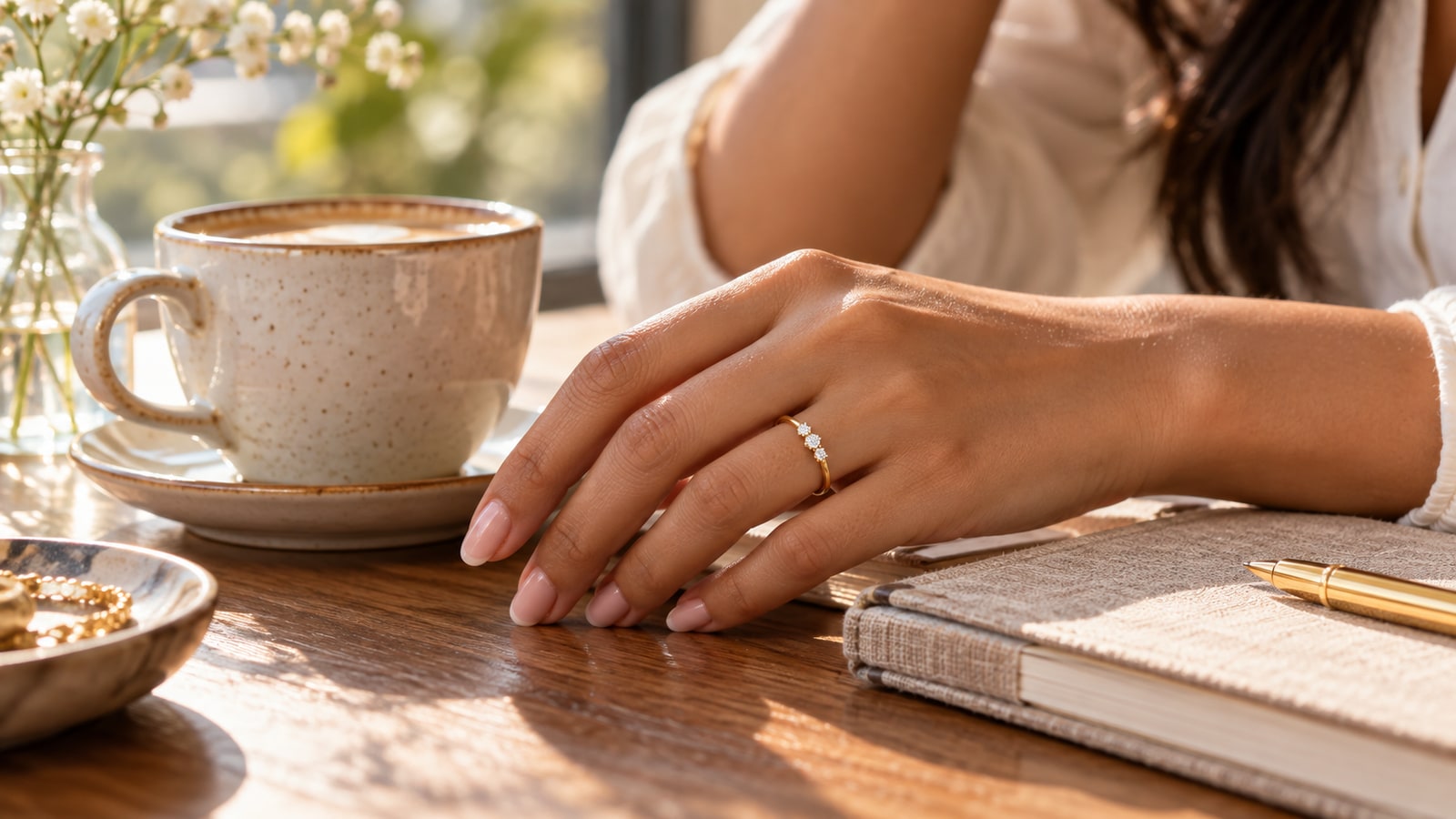
The cover is an AI-generated editorial illustration of a delicate gold-and-diamond ring worn beside a coffee cup and planner. It does not show a specific K Gold product.