

Your favourite jewellery, from morning to night
There is something lovely about finding jewellery that feels like part of you. The diamond studs you reach for before your first coffee. The delicate gold chain that works with every neckline. The ring that makes even an ordinary workday feel a little more personal.
It is tempting to leave those pieces on through everything. But can you really wear diamond jewellery 24/7, including in the shower, while sleeping and at the gym?
You can enjoy fine jewellery every day, but giving it a break during certain activities is the better long-term habit. Diamonds resist scratching, yet a hard knock can still chip them. Their gold settings, delicate prongs, earring posts and chains need care, too. A grading report describes a diamond’s characteristics; it does not make the finished piece damage-proof. GIA explains the difference between diamond hardness and toughness.
The good news: caring for your everyday pieces does not need to become another complicated routine. A few well-timed breaks make a difference.
Can you shower in diamond jewellery?
If you have accidentally showered with your diamond studs on, there is usually no reason to panic. Brief exposure to ordinary tap water is unlikely to suddenly ruin solid gold or an untreated diamond.
The more common problem is what comes with the water. Soap, conditioner and creamy body wash can leave a film on the stone. Hard-water deposits can also contribute to surface buildup. Your diamond may look cloudy because light is passing through a layer of residue—not because the stone itself has changed.
- Do: remove your jewellery before showering and place it in a secure, dry spot away from the sink.
- Do: gently rinse away residue and dry the piece if you forget to take it off.
- Don’t: use shampoo as jewellery cleaner or rub a fine chain vigorously with a towel.
- Don’t: leave tiny studs or rings beside an open drain.
GIA’s jewellery-care guidance recommends limiting exposure to cosmetics and damaging chemicals. Swimming pools and household bleach deserve particular caution.
Can you sleep in dainty diamond studs or rings?
Small jewellery may feel unobtrusive, but size alone does not make it suitable for sleeping. Raised prongs can catch on blanket threads. Repeated pulling may bend or loosen a setting, increasing the chance of losing a stone. Jewelers Mutual’s guidance on sleeping in engagement rings highlights this risk.
Traditional stud posts can press into the skin against a pillow, and delicate posts may bend under pressure. Fine necklaces can tangle or get pulled while you move.
Our practical recommendation is to remove rings, necklaces and ordinary studs before bed. Keep a small jewellery box on your bedside table, with separate compartments to prevent pieces from rubbing together.
For fully healed piercings, professionally fitted flat-back labret studs may be more comfortable than projecting posts. They still need cleaning and fastening checks. For a new or healing piercing, follow your qualified piercer’s aftercare instructions rather than removing or changing jewellery yourself.
Can you wear diamond jewellery to the gym?
A day at your desk and a set of heavy deadlifts put very different demands on a ring. Pressure between your band and a weight bar can scratch, flatten or bend the metal. A slim 14K ring is not immune to force, and choosing 18K does not remove the risk. Thickness and construction matter as much as the karat stamp.
- Weights and exercise machines: remove rings before gripping equipment. Store them in a zipped jewellery case, rather than loose in your gym bag.
- Contact sports and vigorous workouts: take off jewellery that could catch, pull or strike something.
- Sweaty sessions: perspiration, skin oils and products can collect around settings. A little sweat will not dissolve a diamond, but keeping the piece clean and dry is a useful habit.
- Swimming and hot tubs: remove fine jewellery before entering the water.
Chlorine can damage some of the metals alloyed with gold, potentially weakening settings and prongs. GIA’s advice on pools and hot tubs explains why diamond jewellery should come off before a swim.
Perfume and lotion: last on, first off
Think of jewellery as the final step in getting ready. Apply skincare, body lotion and perfume, let your skin dry, get dressed, then put on your favourite pieces. At night, remove them before cleansing, showering or applying moisturiser.
Avoid spraying perfume directly onto your necklace. When applying hand cream at home, place your ring in its box and put it back on after the cream has absorbed.
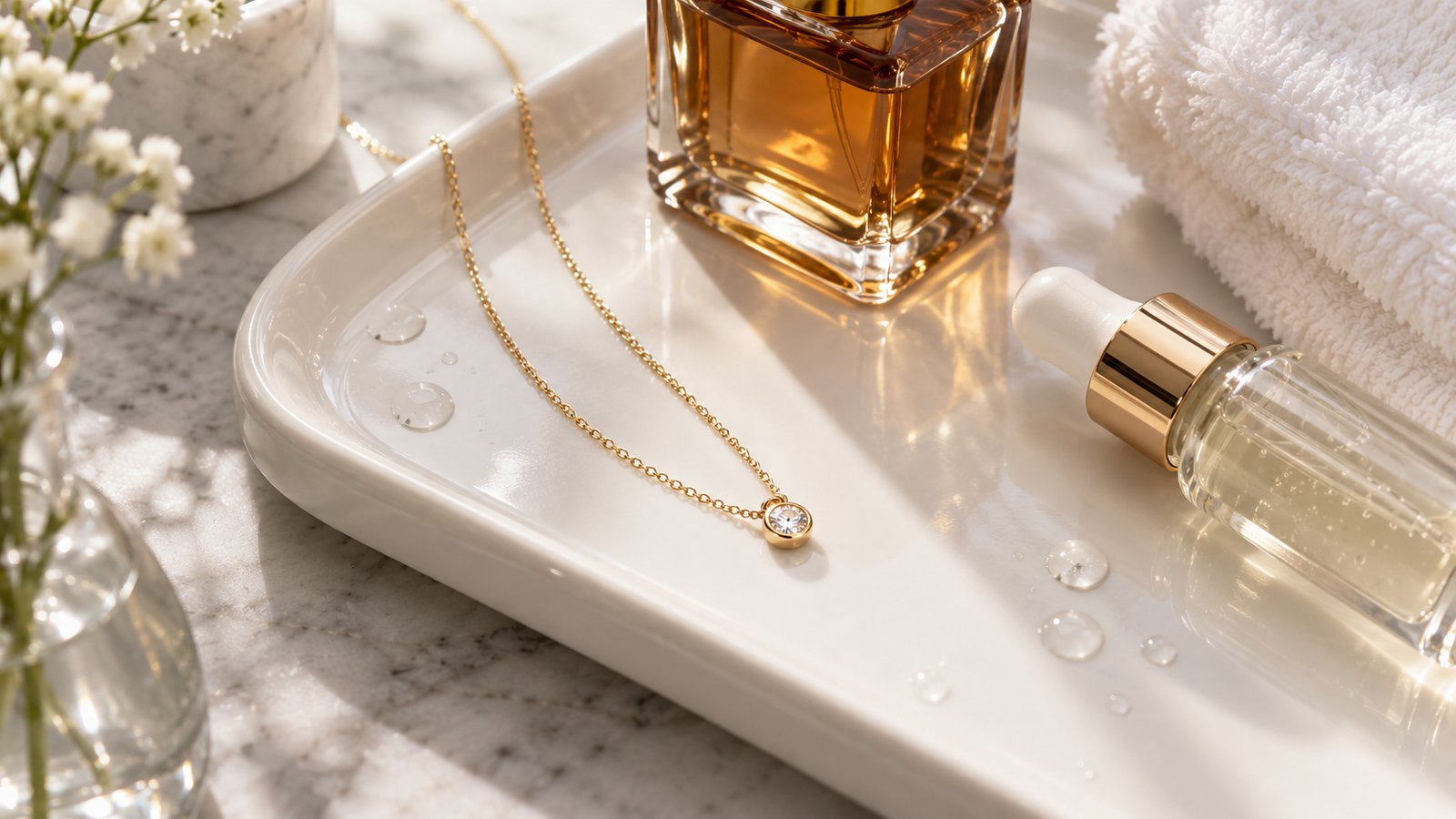
A bathroom tray can make a beautiful styling surface, but a dry storage spot away from splashes is better for your daily routine.
Which minimalist styles are best for frequent wear?
No fine-jewellery style is guaranteed to withstand every activity around the clock. But some designs offer fewer catching points and a more comfortable profile for everyday life.
- Low-profile bezel settings: a smooth metal rim surrounds the diamond’s edge, reducing exposed prongs that might catch. Consider this style for studs or a dainty pendant, while remembering that its chain and clasp still need care.
- Flat-back labret studs: a smooth backing may feel more comfortable than a projecting post. Correct post length, a suitable alloy and a secure fastening are essential. Mejuri’s closure guide explains their construction.
- Smooth, sleek bands: without raised stones or sharp details, they have fewer snagging points. Choose adequate thickness; very thin or hollow designs still deserve protection from pressure.
Whether you prefer yellow or white gold, ask about the finished piece’s construction, fastening and care requirements. A side-view photograph can tell you more about a setting’s height than a front-facing product image. If jewellery begins catching on clothing, have it inspected.
A three-minute sparkle refresh after lotion
If fresh lotion has left your diamond looking dull before a meeting, a gentle refresh may help. This is for light, recent residue; stubborn buildup may need a longer clean or professional attention. Three minutes is a suggested routine, not a guaranteed deep-cleaning time.
- First minute: add a drop or two of mild dish soap to a small bowl of lukewarm water. Wet the piece gently and let the residue soften.
- Second minute: use a clean, very soft brush to lightly clean accessible surfaces and the diamond’s underside. Avoid pulling prongs or forcing bristles into tiny gaps.
- Third minute: rinse in a separate bowl of clean water and pat dry with a soft, lint-free cloth. Allow moisture around the fastening to dry completely before wearing.
This method is intended for securely set, untreated diamonds in solid gold. Ask your jeweller first if the piece has a loose stone, damaged setting, treatment or other gemstones. Avoid toothpaste, bleach, boiling water and abrasive cleaners. Do not assume a home ultrasonic cleaner is suitable. The gentle cleaning method follows GIA’s diamond-care advice; the three-minute format is our suggestion for a quick surface refresh.
Find jewellery that fits your real day
Start with the pieces you can imagine wearing on an ordinary Tuesday. Explore K Gold’s stud earrings and ask our team about smooth, low-profile options. Browse our pendant collection and enquire about the current availability of dainty bezel-set designs.
Settings and fastenings vary, so check the details of each piece rather than assuming every stud is flat-backed or snag-free. For personal guidance, contact the K Gold team with your preferred metal, budget and daily routine.
Frequently asked questions
Does hand sanitiser harm white gold?
Do not assume an occasional application has ruined your ring. Formulas and jewellery finishes vary, and product residue can be mistaken for damage. Avoid soaking jewellery in sanitiser. If you have secure storage, remove your ring before application and replace it once your hands are dry. White gold’s rhodium finish wears over time; ask your jeweller to check a colour change. Keep up good hand hygiene, and avoid leaving a ring beside a public sink.
Will water rust 14K gold?
14K gold does not rust like iron. However, its alloy contains other metals, and chemical exposure can cause tarnishing or corrosion. Dry your jewellery after an occasional splash, and protect it from pool chemicals, bleach and repeated product buildup. GIA’s white-gold guide discusses water and chemical exposure.
How can I tell if my diamond setting needs attention?
If a stone moves, a prong looks uneven, a clasp will not close properly or the piece starts catching on clothing, stop wearing it and arrange an inspection. Do not repeatedly wiggle the stone to test it. Ask your jeweller how often the specific design should be checked based on how you wear it.
Your favourite jewellery can be part of everyday life. A short break before bed, a shower or a workout simply helps you keep enjoying it.
The cover and vanity images are AI-generated editorial illustrations, not photographs of stocked K Gold products.