
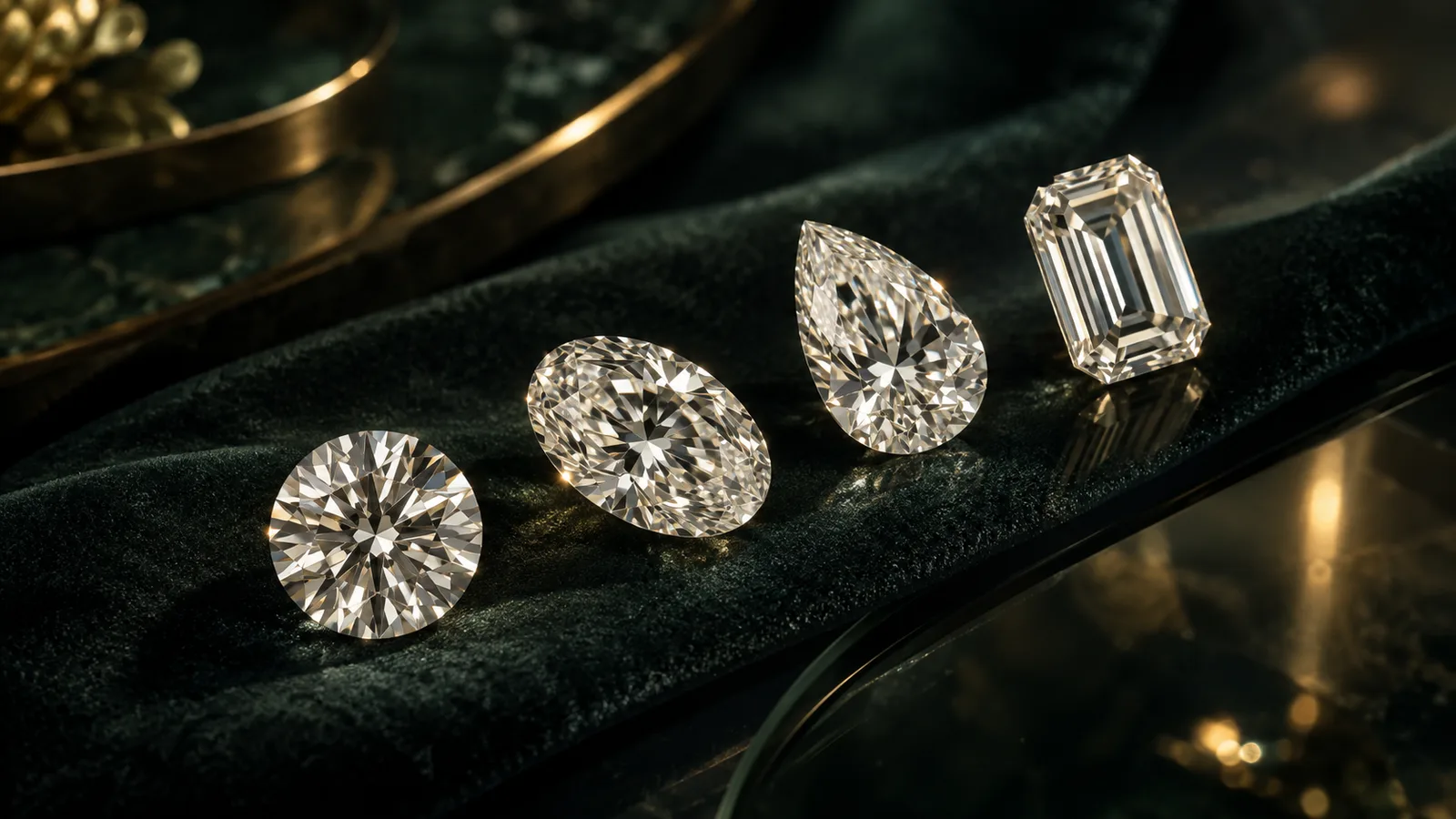
A diamond’s outline is often the first detail you notice. Some people return to a simple circle; others pause at an elongated curve or a precise rectangle. As you explore K Gold’s ring collection, begin with that instinct and give yourself time to compare the complete design.
This guide introduces round, oval, pear and emerald-cut diamonds, with ways to narrow your personal shortlist. Once an outline catches your eye, our guide to bezel, east-west and bold gold rings can help you consider how the setting changes its character.
Diamond Shape and Cut: Two Different Questions
Shape describes the outline seen from above. Cut also concerns the arrangement and proportions of the facets and the way they interact with light. Choosing an oval outline, for example, does not tell you everything about the appearance of an individual stone. GIA’s introduction to diamond cut explains this distinction.
Round Diamonds: Begin with a Simple Circle
A round brilliant combines a circular outline with brilliant-style faceting. Try its symmetry beside a curved band, then beside a straighter, more angular design. In our styling approach, the circle is a useful starting point: decide what you like about it before adding other shapes to your comparison.
Look at the ring on your hand from a normal distance. Is the outline clear enough for your taste? Do you enjoy the amount of metal surrounding it? Keep a note of those answers rather than judging only a tightly cropped photograph.
Oval Diamonds: Explore the Length of the Curve
An oval has a rounded, elongated outline. Ovals vary in proportion, so two stones with the same shape name can look noticeably different. Put a fuller oval and a slimmer one on your shortlist and describe which outline you prefer before discussing a particular ring.
For a styling comparison, look at an upright oval and a horizontal, east-west arrangement. Keep the band as similar as possible. Changing one detail at a time helps you see whether it is the outline, the orientation or the whole setting that appeals to you.
Pear Diamonds: A Curve with a Point of Interest
A pear combines a rounded end with a pointed tip. Ask the jeweler how the setting protects that point. GIA’s diamond shape guide discusses this setting consideration alongside the different silhouettes.
We like to compare a pear by itself before adding a companion band. Turn your hand naturally and look from different angles. If you wear other rings, bring them to the comparison so you can decide how much space you want around the pointed outline.
Emerald-Cut Diamonds: Look at the Geometry
An emerald-cut diamond typically has a rectangular outline with cropped corners and long step facets. Those facets create broader reflections than the many small flashes associated with brilliant cuts. The name describes the cutting style; it does not mean the diamond is a green emerald.
Try an architectural pairing with a plain band, then compare a softer, rounded band. Neither arrangement needs extra detail everywhere. Our suggestion is to let one feature lead: the stone’s geometry, the sweep of gold or the relationship between the two rings.
A Practical Way to Shortlist Diamond Shapes
- Choose two outlines. Start with your first instinct and one alternative you are curious about.
- Compare complete designs. Include a side view and a comfortable, natural hand position.
- Bring your usual jewelry. Notice the relationship to pieces you already enjoy wearing.
- Write down the reason. “I like the rounded outline” is more useful than keeping dozens of unrelated photos.
Discuss the specific stone, its measurements and available grading information with your jeweler. A shape name is a starting point for that conversation, and your shortlist can become smaller as the details become clearer.
Diamond Shapes: Your Questions Answered
Is there one best diamond shape for everyone?
No single outline has to suit every person. Begin with what you enjoy seeing on your own hand, then compare the full ring and how it fits your routine. A favorite does not need to match somebody else’s shortlist.
Can the same diamond shape feel different in another setting?
Yes. Try a restrained band beside a broader one, or compare upright and horizontal orientations for an elongated shape. Looking at one change at a time makes your preference easier to explain.
Should I choose a shape before thinking about a ring stack?
You can start with either. If you already own a band you want to keep wearing, bring it along. If you are beginning with a diamond ring, leave the companion choice open until you have tried the pieces together.
Build a Look Around Your Favorite Shape
Continue with our mixed-metal ring stacking guide, or explore K Gold’s current rings with your favorite outline in mind. For more technical background, return to GIA’s shape and cut resources linked above.