
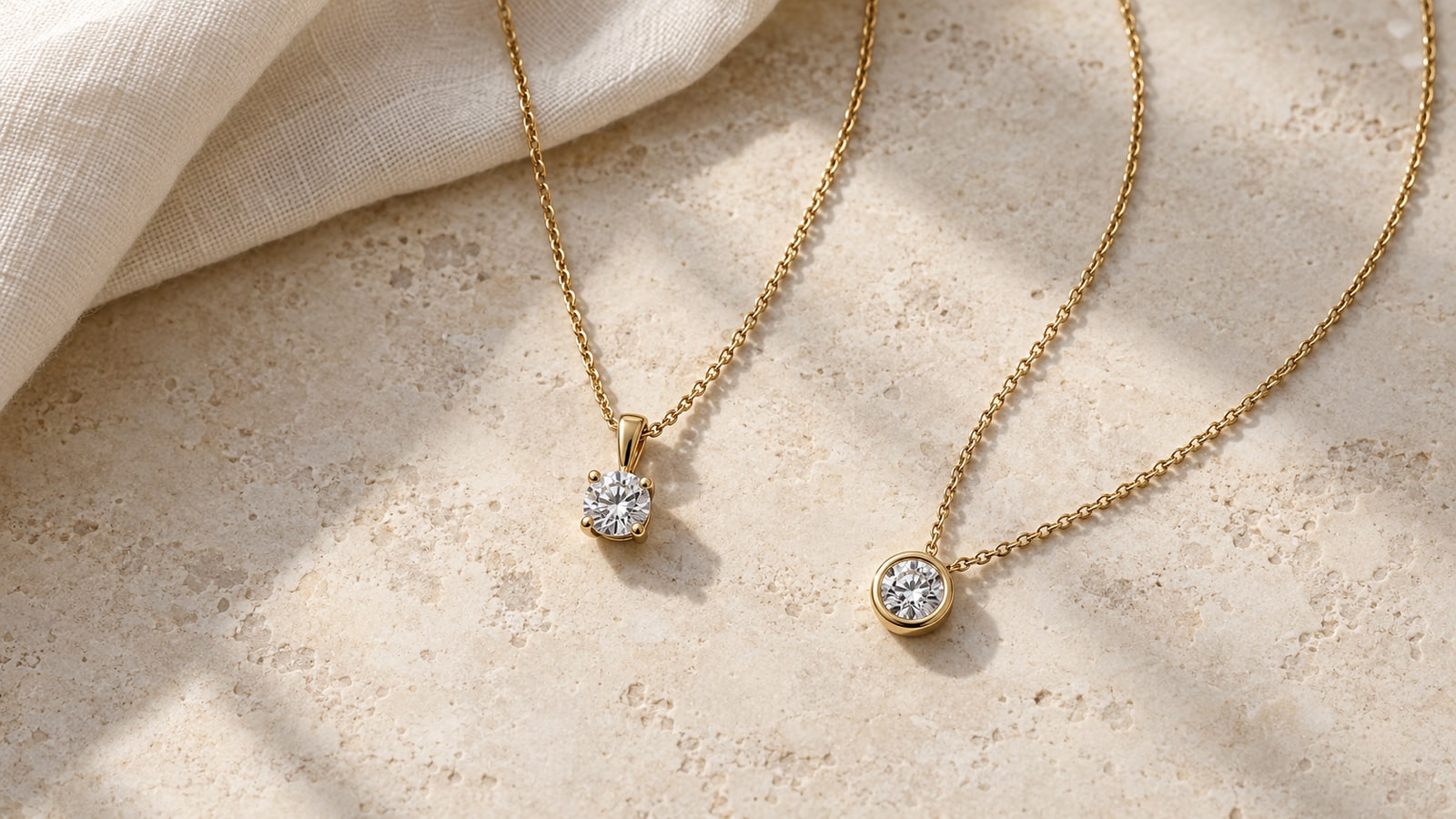
The pendant you notice in a close-up photograph can look quite different when you put it on. A chain changes where the diamond sits, a setting changes its outline, and your usual neckline changes the whole effect. Start with K Gold’s pendant collection and picture each design with an outfit you already enjoy wearing.
This guide takes you through those decisions in a practical order: length, setting, proportions and the details to confirm before buying. If you are building a small jewellery collection, our capsule jewellery wardrobe guide can help you decide what role a pendant will play.
Start with Where You Want the Pendant to Sit
Try your favourite shirt, an open collar and a simple T-shirt before choosing a chain length. Decide whether you want the pendant above the neckline, inside its opening or over the fabric. These are styling choices; the same necklace can feel understated with one outfit and become the focal point of another.
Measure a necklace you already like from end to end while it lies flat and unclasped. Check how the seller measures the proposed chain, whether the clasp is included and whether the pendant adds a separate drop. A product photograph alone cannot tell you the finished length.
16, 18 or 20 Inches: How to Compare Chain Lengths
These lengths are useful starting points for a comparison. Where each one falls depends on your neck circumference, build and the pendant itself. Tiffany & Co.’s necklace sizing guide recommends trying a piece of string cut to the proposed length to judge its position.
- 16 inches, approximately 41 cm: try this when you want a shorter look. Check that it feels comfortable and leaves enough room for natural movement.
- 18 inches, approximately 46 cm: compare this with the shorter option using the same top. Notice whether the pendant clears the neckline or rests against its edge.
- 20 inches, approximately 51 cm: try this for a lower position. Check the result over fabric as well as against skin.
Hold the ends of the string loosely; do not tie it around your neck. Use it only to estimate position, then try the actual necklace when possible. If a chain is adjustable, confirm its shortest and longest wearable lengths instead of assuming every design has an extender.
Prong or Bezel: Choose the Outline You Enjoy
A prong setting uses small metal claws to hold the diamond. A full bezel surrounds the edge with a continuous metal rim. GIA’s guide to settings explains these constructions and distinguishes them from design styles such as solitaire and halo.
For a pendant, compare how much metal you want to see around the stone. Prongs leave more of its outline visible; a bezel adds a defined border. A solitaire centres the design on one stone, while a halo frames a centre stone with smaller gems. A solitaire can therefore use either prongs or a bezel.
Look at the side and back as well as the front. Ask how the finished setting feels against skin and whether any edges catch on clothing. Neither setting name guarantees good workmanship or removes the need for checks by a jeweller.
Judge Size on the Neck, Then Read the Diamond Details
Ask for the pendant’s width and height in millimetres, including its hanging loop where relevant. Look at an image showing its scale on a person, then compare the measurements with jewellery you own. A close-up that fills your screen is useful for detail but gives little sense of everyday proportions.
GIA describes diamond quality through cut, colour, clarity and carat weight. Carat measures weight, so also ask about the stone’s dimensions and the complete pendant’s outline. For a design with several diamonds, confirm whether the stated weight refers to the centre stone or the total across the piece.
Request clear information about whether the diamonds are natural or laboratory-grown, their stated quality and any accompanying report. When a grading report is supplied, check that it describes the diamond being offered and verify it with the issuing laboratory. GIA’s online buying advice explains why specific descriptions and report verification matter.
Check the Chain, Clasp and Complete Price
A pendant purchase is easier to compare when you know exactly what is included. Before placing an order, ask:
- Is the chain included? Confirm the price for the complete necklace you intend to wear.
- What metal is each part? Check the pendant and chain separately, including their stated gold purity.
- Does the chain suit the pendant? If you plan to use your own chain, have the jeweller assess its condition, fittings and suitability for the pendant’s weight.
- Can you manage the clasp comfortably? Ask to see how it opens and closes, and whether any length adjustment is available.
- What happens after purchase? Read the current delivery, return and repair terms for the particular piece, especially if you request a modification.
For a closer look at gold purity, read our 14K versus 18K gold guide. Keep the comparison tied to the actual necklace: a preferred metal colour is one decision, and construction is another.
Style It with Pieces You Already Wear
Start with the pendant on its own and take a photograph at a normal distance. Then add your usual earrings. If you like a simple pairing, read our guide to choosing diamond studs as you compare their scale with the pendant.
For layering, try a shorter plain chain with the pendant below it. Move naturally and see whether the pieces stay where you want them. If they repeatedly overlap or catch, a single necklace may be the more comfortable choice. Check compatible lengths and fittings with your jeweller before buying a second chain just for this combination.
Choosing something for everyday outfits also means planning its care. Our guide to sleep, shower and gym care explains when to put jewellery away and what to discuss with your jeweller.
Diamond Pendant Questions
Is 18 inches the best length for everyone?
No. Compare the position on your own neck with the clothes you wear most. Start with a necklace you already find comfortable, then check the proposed chain length and pendant drop. An adjustable design is useful only if its available lengths suit you.
Is a bezel pendant always better for everyday wear?
The right choice depends on the finished piece and your preferences. A bezel gives the diamond a metal border; prongs create a more open outline. Inspect the back, edges, chain connections and clasp, and ask your jeweller about care for that design.
Can I buy the pendant first and add any chain later?
Confirm compatibility before buying either piece. The chain and its end fittings must work with the pendant’s opening, and its construction needs to suit the pendant. If the necklace has a fixed attachment, a different chain may require professional alteration.
Find a Pendant That Fits Your Routine
Shortlist a shape you enjoy, a length that works with your clothes and a setting that feels comfortable. Then compare the complete specifications and price. Browse K Gold’s pendants or contact our team with a design you like and the chain length you have in mind.
The cover is an AI-generated editorial illustration of setting styles. Please use individual product listings for the designs and specifications currently available.