
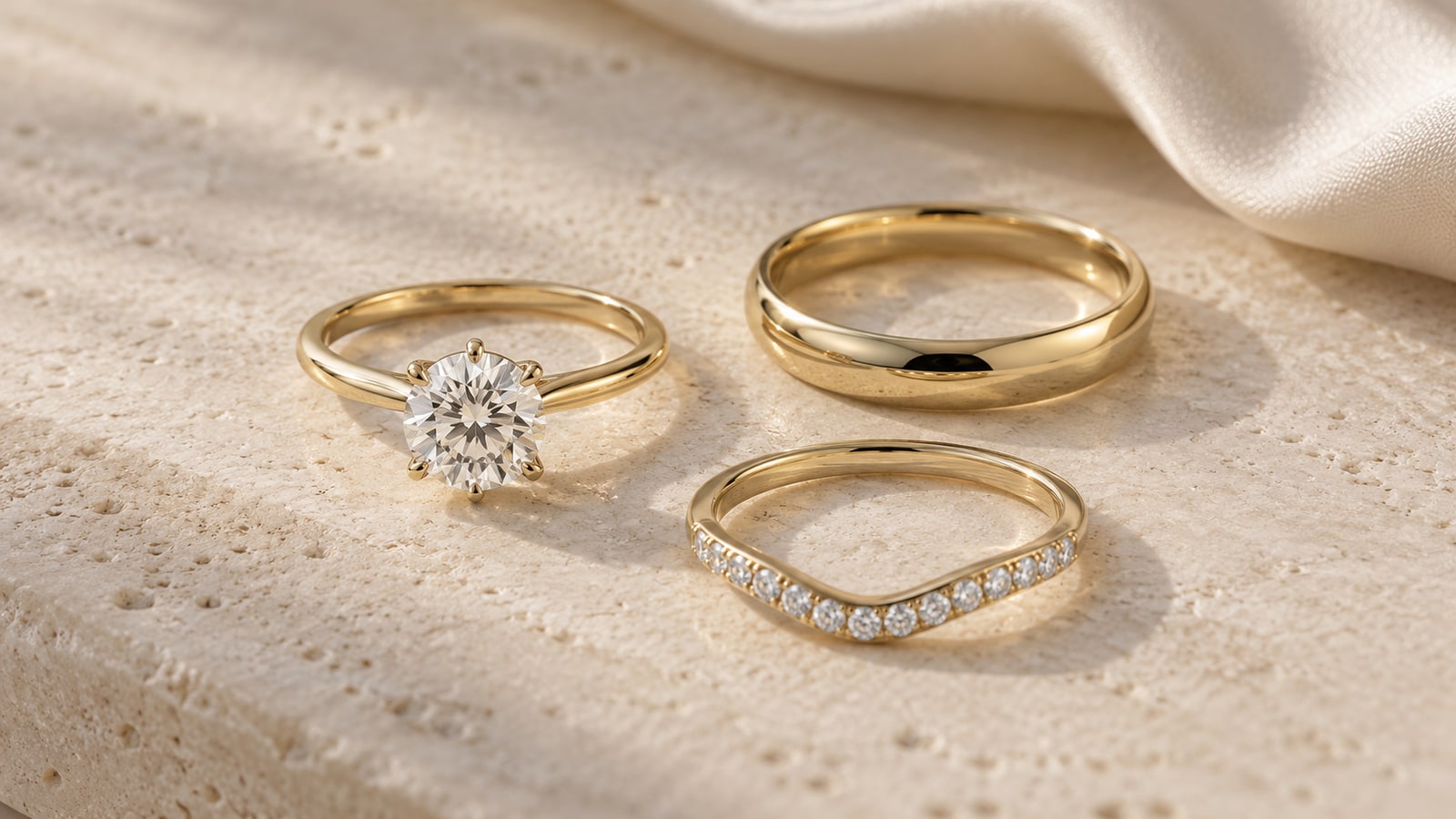
A wedding band can change the way your engagement ring looks and feels. Before choosing extra diamonds or matching every detail, look at how the two rings sit together. Browse K Gold’s ring collection with your existing ring in mind, or start with our guide to balanced ring stacks if you enjoy mixing finishes and colors.
The aim is a pair you enjoy wearing together and a band you still like on its own. Work through the shape, width and fit first, then decide how much sparkle you want.
Start with the Side View of Your Engagement Ring
A photograph taken from above tells you about the diamond’s outline. A side view shows the space a wedding band has to occupy. Look at the structure beneath the center stone, the shoulders of the ring and any details projecting beyond the band.
GIA’s guide to ring settings distinguishes the head that holds the gemstone from the shoulders and the shank, or circular band. That distinction is useful when comparing two rings: a similar-looking center stone does not tell you whether the surrounding metalwork will fit beside the same wedding band.
Take your engagement ring to the fitting when possible. If you are shopping remotely, request a side-view photograph or video showing the exact pairing. Ask the jeweler to check where the pieces meet instead of judging compatibility from their product names.
Straight or Curved: Choose the Shape of the Pair
A straight wedding band gives you a simple outline to compare first. Some engagement-ring settings leave room beside them; others create a visible gap. Berlinger’s guide to contour bands describes how a shaped band can follow an engagement ring’s profile, particularly where a low setting prevents a straight band from sitting closely alongside it.
- Try a straight band if you like a clean, uninterrupted line. Look at the pairing with your hand relaxed, not only with the rings pressed together for a photograph.
- Try a curved or contour band if you want its outline to follow the center setting. Compare the actual curve with your ring; the label alone does not guarantee a match.
- Consider a visible gap if you enjoy seeing each ring separately. A small space can be part of the look, provided a jeweler confirms that the combination is suitable to wear.
Remove the engagement ring for a moment and look at the wedding band alone. A curve that frames a center stone beautifully will create a different silhouette by itself. Decide whether both versions appeal to you.
Compare Width and Comfort Together
Ask for each band’s width in millimeters, then try the pair as a complete set. GIA’s ring-sizing guidance notes that wider rings and bridal sets need particular attention during fitting. Do not assume that a size which feels right in one slim ring will feel identical with another band beside it.
Use three simple comparisons: a narrow band that keeps attention on the center stone, a similar-width band for a balanced outline, and a wider band for a stronger presence. These are styling options, not sizing rules. Open and close your hand normally and notice how the pair feels between neighboring fingers.
Have a jeweler confirm the size before ordering. Avoid automatically choosing a larger size to solve discomfort; the complete shape and fit deserve a closer look.
Decide What You Want the Second Ring to Add
Try a plain band first to see a clear line of metal beside the engagement ring. Then compare a diamond band under the same lighting. Ask yourself which detail you notice first and whether that is the effect you wanted.
If your engagement ring already has a detailed band, a simpler companion may make those details easier to appreciate. Beside a plain solitaire, a row of smaller diamonds can introduce a different rhythm. Neither pairing needs to follow a fixed formula; take photographs from the same distance so you can compare the overall impression.
For a diamond band, ask whether the quoted carat weight is the total across the ring, how far the stones extend around it and whether the diamonds are natural or laboratory-grown. Confirm the stated metal and gold purity for each piece. Our 14K versus 18K gold guide explains another useful part of that conversation.
Check Practical Details Before Ordering
- Compatibility: ask the jeweler to inspect the pair together, including any contact with stone settings.
- Resizing: confirm what can be adjusted on this specific design, the permitted range and the cost.
- Care: ask about inspections and maintenance. GIA notes that small stones in pavé designs can need attention and that resizing can be more involved.
- Timing and terms: check the expected delivery date and the return or exchange conditions before choosing a size or adding engraving.
Keep the final shortlist small enough to compare carefully. Save the product references, dimensions and a photograph of your engagement ring together so the jeweler can answer questions about the exact pairing.
Frequently Asked Questions
Does a wedding band have to sit flush with an engagement ring?
No. A close fit and a visible gap create different looks. Choose the appearance you enjoy, then have a jeweler assess the physical fit and the points where the rings meet. Do not force two pieces together to remove a gap.
Should both rings have the same band width?
They do not have to. Similar widths create one kind of balance, while a narrower or wider companion changes the emphasis. Try the full pair and have its fit checked instead of choosing by width alone.
Can I wear the wedding band without the engagement ring?
Yes. If that is part of your plan, include it in your try-on. Look at the band’s outline by itself and check that its fit feels right in both arrangements.
Find Your Pairing with K Gold
Explore K Gold’s current rings, then contact our team with the designs you like and photographs of your engagement ring. Ask about available options and fitting guidance for your particular combination.
For more ideas, read our diamond shape guide and everyday diamond jewelry care guide.
Cover: AI-generated editorial illustration of a solitaire ring and two wedding bands. It does not depict specific K Gold products.